The Wellness Revolution. Why the Future of Healthcare is Happening Before You Get Sick.

For most of modern history, healthcare worked like a repair shop.

  1. Something breaks.
  2. You go to the doctor.
  3. They fix it.

That model built hospitals, pharmaceutical breakthroughs, and lifesaving medical technology. But something big is changing in how people think about health.

Around the world, people are starting to ask a different question.
Not “How do I treat illness?”
But “How do I stay healthy in the first place?”

That shift is fueling what many experts now call the global health awakening. It’s also driving one of the fastest growing sectors on the planet: the global wellness economy.

And here is the interesting part. This movement is not being led only by doctors or healthcare systems. It’s being driven by everyday people like us who want to feel better, live longer, and perform at their best.

The Global Health Awakening

Picture this.

  • Your watch tracks your sleep.
  • Your phone tracks your steps.
  • Your grocery store sells protein powders, probiotics, and plant-based foods.
  • Your friends talk about gut health, meditation, and longevity.
  • Twenty years ago, this conversation barely existed.
  • Today it’s everywhere.

Consumers are no longer satisfied with simply surviving. They want energy. Focus. Longevity. They want to feel good today and protect their health tomorrow. Several forces are driving this shift.

First, technology has changed everything. Wearable devices now track heart rate, sleep cycles, recovery levels, and even stress. People have access to health data that doctors once had only in clinical settings.

Second, information is everywhere. Research about nutrition, exercise, and cellular health spreads quickly online. People are learning that daily habits shape long-term health outcomes.

Third, demographics are changing. Populations are aging, and people want to stay active longer. At the same time, younger generations are thinking about health much earlier in life.

The result is a massive surge in demand for things like:

  • Proactive nutrition
  • Longevity science
  • Personal health routines
  • Mental resilience
  • Natural health solutions

This is not a niche market. It’s a global movement that’s redefining how people approach health.

From Sick Care to Proactive Wellness

Here is where the real transformation begins. For decades, healthcare operated under what many experts call the “sick care” model. The process was simple.

  1. Wait until symptoms appear.
  2. Diagnose the problem.
  3. Treat the illness.

This system saved millions of lives. But it’s also extremely expensive and often arrives late in the process.

Proactive wellness flips that model. Instead of waiting for illness, the goal is to strengthen the body before problems develop.

That means focusing on everyday habits like:

Family Hiking

  • Nutrition
  • Exercise
  • Sleep quality
  • Stress management
  • Supplementation

Think of it like maintaining a car. You change the oil regularly so the engine doesn’t fail. You rotate the tires so they last longer. You maintain the system so major breakdowns never happen.

Proactive health works the same way.

It doesn’t replace traditional medicine. Hospitals and doctors will always be essential for serious illness and injury. But proactive strategies reduce the chances that people reach that stage in the first place.

Healthcare organizations are beginning to understand this shift.

Companies are investing in employee wellness programs. Healthcare providers are using data to identify risks earlier. Employers are encouraging healthier lifestyles to improve productivity and reduce burnout.

The entire system is slowly moving toward keeping people healthy rather than only treating them when they become sick.

Where the Future of Health Is Heading

The intersection of the wellness economy and modern healthcare is creating one of the most exciting opportunities of the next decade.

Demand for proactive health solutions is accelerating worldwide. People are investing in nutrition, daily health habits, and science-backed wellness tools that support long-term vitality.

But the future will not be driven by products alone. People want guidance. They want trusted information. They want communities that support healthier living. On top of all that, they want organizations that combine science, transparency, and practical solutions.

This is exactly where companies like USANA Health Sciences have stepped forward. For more than three decades, USANA has focused on one simple but powerful idea. Health should be built every day.

Through science-backed cellular nutrition, rigorous quality standards, and a global community focused on wellness, USANA has positioned itself at the center of this movement. Our mission is not just to sell supplements. It’s to help people create a strong daily foundation for lifelong health.

Most of all, people want control over their own health. And that may be the biggest shift of all. Health is no longer something people wait to repair; it’s something they build every single day.

As this mindset spreads, the wellness economy will continue to expand and healthcare will continue to evolve. Companies that combine credible science, trusted leadership, and a commitment to improving lives will help shape this next chapter of global health.

I see that the future of health will not be defined only inside hospitals. It will be shaped by the everyday choices people make to live longer, stronger, and healthier lives. And for millions around the world, those daily choices increasingly begin with a foundation of wellness built through companies like USANA.


Are we connected on LinkedIn? There, I share posts about professional development skills, self-care reminders, and other relevant topics.


Successful Leaders See Reading as a Competitive Advantage

As businesses navigate accelerating change and increased market pressure, I am spotlighting a powerful leadership tool during National Reading Month: disciplined, intentional reading.

National Reading Month, observed in March to promote literacy and lifelong learning, often emphasizes youth engagement. I believe its value extends far beyond the classroom and into the executive suite.

Reading stretches your thinking. It challenges assumptions, builds clarity, and sharpens your ability to communicate. Those are leadership skills.

While some professionals may view the heightened focus on reading as routine, I argue that the increased emphasis this month delivers measurable returns that compound over time. I call reading “essential training for the executive mind,” strengthening mental discipline, improving analytical ability, expanding imagination, and boosting memory.

One clear value of reading is that studying and internalizing principles strengthens character and changes destiny.

National Reading Month: Intentional Learning

In All the Right Reasons, I reflect on Benjamin Franklin’s commitment to tracking and living his core values. By writing, prioritizing, tracking, and clarifying his core values, Franklin came to understand them better and developed a path to integrate them into his life.

I summarize the lesson this way: I’ve learned from the Ben Franklin Principle that when you commit to living according to your core values, you change your destiny.

For me, that is the deeper return on reading. Intentional learning, reflection, and application of principles, often gained through reading and study, elevate character, sharpen decision-making, and ultimately shape long-term success.

I have embedded this philosophy into USANA’s leadership culture by highlighting the influence of Made to Stick by Chip Heath and Dan Heath.

The principle is: What are we doing here at USANA that makes USANA sticky? What makes people want to stay involved and stay connected? Those ideas, how do they blossom and how do they grow? Why do some survive and some don’t?

I immediately translated insight into action by asking the entire management team to read Made to Stick and decide which principles can be applied to their own areas throughout the company.

Reading is not passive consumption. It is strategic execution. The lessons from Made to Stick inform how USANA evaluates messaging, strengthens culture, and builds long-term loyalty.

Reading as a Competitive Advantage

Here are five ways reading functions as a competitive advantage for successful professionals:

  1. Strategic foresight: Exposure to diverse ideas helps leaders identify patterns early and anticipate market shifts.
  2. Sharper decision-making: Engaging with complex arguments improves clarity under pressure.
  3. Cognitive resilience: Reading increases focus and strengthens composure in high-stakes moments.
  4. Stronger communication: Consistent readers articulate vision with precision and authority.
  5. Innovation through cross-pollination: Reading outside one’s field introduces frameworks that spark new solutions.

Reading is one of the simplest habits you can develop. But over time, it compounds. It builds perspective. It builds insight. Simply put, readers are leaders.

By elevating reading from hobby to discipline, I believe leaders strengthen their thinking, fortify their character, and position their organizations for sustained growth.

What I’m Reading

Occasionally, I’ll share thoughts on books I’ve enjoyed and found valuable.

I shared a version of this article in a news release on March 2, 2026. USANA Health Sciences, a global leader in health and wellness products, has long recognized the importance of social wellness in building a successful business. Since its founding in 1992, USANA has focused on clear, concise communication to build trust with its customers and distributors in 25 countries. For more information about USANA Health Sciences and its dedication to promoting health, wellness, and entrepreneurial success, visit USANA.com. 

Productivity Over Promises: Why Execution Is the New Leadership Currency

Economic storms have a way of clarifying what truly matters. I’ve found that when the winds of uncertainty pick up, the leaders who succeed are not the ones with the most elaborate visions. Instead, they build strong foundations and drive forward with steady, disciplined action. In today’s business climate, that lesson has returned with force.

The era of valuing promises over proof is ending. Boards and stakeholders are no longer satisfied with compelling stories; they demand tangible results, measurable output, and a clear return on investment.

With the rise of AI, the pressure is even greater for leaders to turn potential into performance. Vision still matters, but vision without execution is just a daydream. This is a fundamental shift from “what could be” to “what is being done.”

In this new paradigm, leadership currency is simple: disciplined execution.

The Farmhand and the Storm

Why should we build a solid foundation? Because storms will rage.

In my book, “All the Right Reasons,” a story is told about a farmhand who could “sleep through a storm.” His secret was simple: he had already done the hard work before the storm arrived. Everything was tied down, the animals were safe, and the firewood was stacked. Because he was prepared, he could rest with confidence.

That is what masterful execution looks like today. It is quiet preparation. It is steady discipline. It is the daily work that keeps an organization moving forward, even when no one is watching. The companies that will thrive in 2026 are not the ones talking the most about AI; they are the ones using it to make work faster, clearer, and more human by turning investment into measurable outcomes.

The Human Side of Productivity

February is often associated with kindness, connection, and relationships. That may seem far removed from conversations about productivity. But I’ve found the opposite to be true.

In the workplace, reliability is one of the purest forms of kindness. When someone keeps commitments, meets deadlines, and communicates clearly, they reduce stress for everyone around them.

Execution is not just about results. It is about respect. It shows colleagues that their time and energy matter. It creates stability and trust, especially in uncertain times. When leaders focus on execution, they give their teams clarity and confidence. That is a powerful act of service.

5 Ways to Turn Vision into Reality in 2026

Improving execution discipline requires a cultural shift that involves every team member. I’ve found five practical ways executives and colleagues can live this principle every day.

1. Build a Values-First Execution Culture

Execution starts with clarity. When an organization defines what truly matters, decisions become easier and faster. Values act as a filter for every initiative.

2. Turn Big Goals into Small, Daily Disciplines

Big visions can feel overwhelming, but the Piano Principle reminds us that dreams require sacrifice and steady effort. Break large initiatives into small, daily actions. Measure progress weekly. Momentum grows through consistent, incremental wins that drive long-term productivity.

3. Do the Hard Thing When It Is the Right Thing

Sometimes the most critical act of execution is choosing integrity over speed. I’ve seen projects scrapped because they failed quality standards. It costs more in the short term, but long-term trust always wins. Every time. Execution is integrity in action.

4. Master the Dorothy Principle: Make Relationships Your Priority

Productivity is a team sport. Strong execution depends on trust, communication, and respect. The Dorothy Principle teaches that nothing matters more than relationships. When teams connect, they collaborate better, solve conflicts faster, and go the extra mile. Foster open communication so people feel safe to speak up.

5. Practice Kindness Through Reliability

In the workplace, kindness shows up through action. It’s the leader who keeps promises, the manager who clears obstacles, and the colleague who helps others succeed. Reliability—being prepared and meeting deadlines—is one of the greatest acts of kindness. It respects others’ time and reduces stress across the team. By honoring your word with action, you show your team you care.

Leadership for All the Right Reasons

In the end, leadership is not about the speeches. It is about the example you set. People would rather see a sermon than hear one. As we move through this year, a time that often celebrates connection, the most powerful thing a leader can do is simple: deliver on your commitments. Help others succeed. Build something so solid that your team can rest easy, even when the storms come.

That is the leadership standard emerging in 2026. Not promises. Not projections. Results.

Are we connected on LinkedIn? There, I share posts about professional development skills, self-care reminders, and other relevant topics.

Self-Renewal: 6 Steps to Break Comfort Zones for Strategic Growth

As organizations face rapid market disruption and evolving leadership demands, Feb. 2 marks Self-Renewal Day, a pivotal time for business leaders to recalibrate strategies and personal development.

Growth does not happen by accident; it happens by choice. Self-Renewal Day is designed to prompt people to evaluate their lives, challenge complacency, and take deliberate steps toward personal and professional renewal.

All the Right Reasons | Kevin GuestThis annual observance is a critical reminder that sustained corporate success and operational advancement begin with the individual leader’s commitment to breaking free from the status quo.

Comfort is seductive, but nothing meaningful grows there. Renewal requires movement. It requires courage. It requires choosing long-term fulfillment over short-term ease.

Self-Renewal: Realignment for Purpose

One of the most powerful examples I shared in my book, All the Right Reasons, is my decision to walk away from a lifelong dream of becoming a full-time rock musician. Music was my passion. I had talent. I had momentum. But I felt a deeper pull toward leadership, service, and building something that would impact lives at scale.

That choice was not easy. It meant letting go of an identity I loved and starting again in unfamiliar territory. It also became the turning point that led to leadership at a global company and a life aligned with deeper values.

That is self-renewal: Not reinvention for show but realignment for purpose.

I’ve learned the hardest choices are often the right ones. Renewal begins when you decide who you are becoming, not just who you have been.

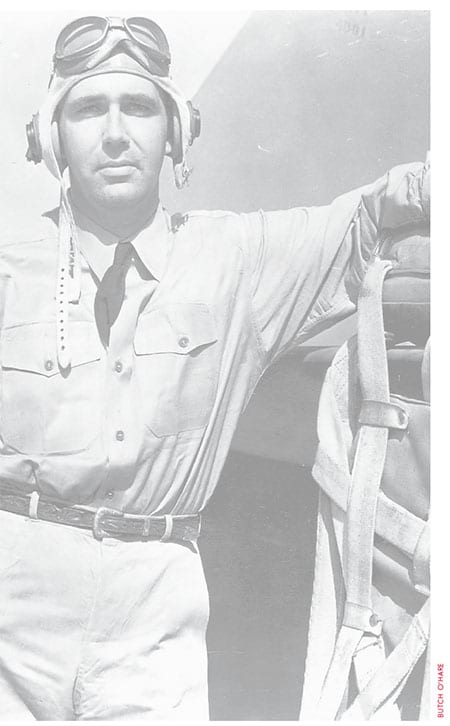
The Butch O'Hare Principle - Butch O'Hare - All the Right ReasonsIn All the Right Reasons, I illustrate this principle through the “Butch O’Hare Principle,” which emphasizes that every individual has the power to change. I recount the story of Butch O’Hare, a World War II pilot who transformed from an undisciplined young man into a hero through rigorous self-discipline and a commitment to change.

This anecdote underscores a vital lesson for modern executives: transformation requires the courage to abandon familiar patterns in favor of difficult growth.

For leaders navigating complex changes, stagnation is the enemy of progress. The most successful executives are those who continuously optimize their skill sets and challenge their own assumptions. To facilitate this journey of renewal, here are six concrete steps for leaders ready to elevate their performance:

1. Conduct a Personal Audit

Write down where you are coasting. Career. Health. Relationships. Skills. Growth stalls where discomfort is avoided.

2. Reconnect to Your Core Values

Values, not ambition, should drive decisions. Start by identifying three non-negotiable principles that guide how you live and lead.

3. Make One Courageous Decision

Renewal does not require 10 changes; it requires one honest one. End something that no longer fits. Start something you have delayed, and stick with it consistently.

4. Prioritize High-Value Relationships

In All the Right Reasons, the “Dorothy Principle” states that nothing is more important than relationships. Evaluate your network. Are you surrounded by peers who challenge your thinking and drive you toward strategic alignment or those who merely echo your current views?

5. Commit to Positive Self-Talk

The “Cardboard Keyboard Principle” highlights the impact of internal dialogue. Leaders must cultivate a mindset that reinforces capability and vision, empowering them to lead teams with conviction and clarity.

6. Reframe Resilience

Resilience is the capacity to adapt and thrive amid a crisis. View setbacks as essential experiences for future decision-making, not failures.

A Way of Life

Life rewards those who act with intention. Renewal is not a one-time event. It is a way of living for all the right reasons. February 2 is the invitation. The next step is yours.

By integrating these steps, business leaders can transform Self-Renewal Day from a calendar event into a catalyst for long-term strategic growth.

It’s an opportunity to empower yourself, innovate within your role, and navigate the future with renewed purpose.

I shared a version of this article in a news release on Feb. 2, 2026. USANA Health Sciences, a global leader in health and wellness products, has long recognized the importance of social wellness in building a successful business. Since its founding in 1992, USANA has focused on clear, concise communication to build trust with its customers and distributors in 25 countries. For more information about USANA Health Sciences and its dedication to promoting health, wellness, and entrepreneurial success, visit USANA.com. 

Foundational ‘Why’ is Critical for Organizational Success

In my years of leading teams and pursuing excellence, I’ve observed a common thread that separates lasting success from fleeting wins. It isn’t merely about what we do, but why we do it. Understanding this core motivation is the single most powerful catalyst for breakthrough performance.

So many leaders get caught in the cycle of daily tasks, focusing on the “what” and “how,” yet they neglect the foundational “why.” What is the ultimate purpose driving your organization forward? What is the deep-seated reason your team shows up every day?

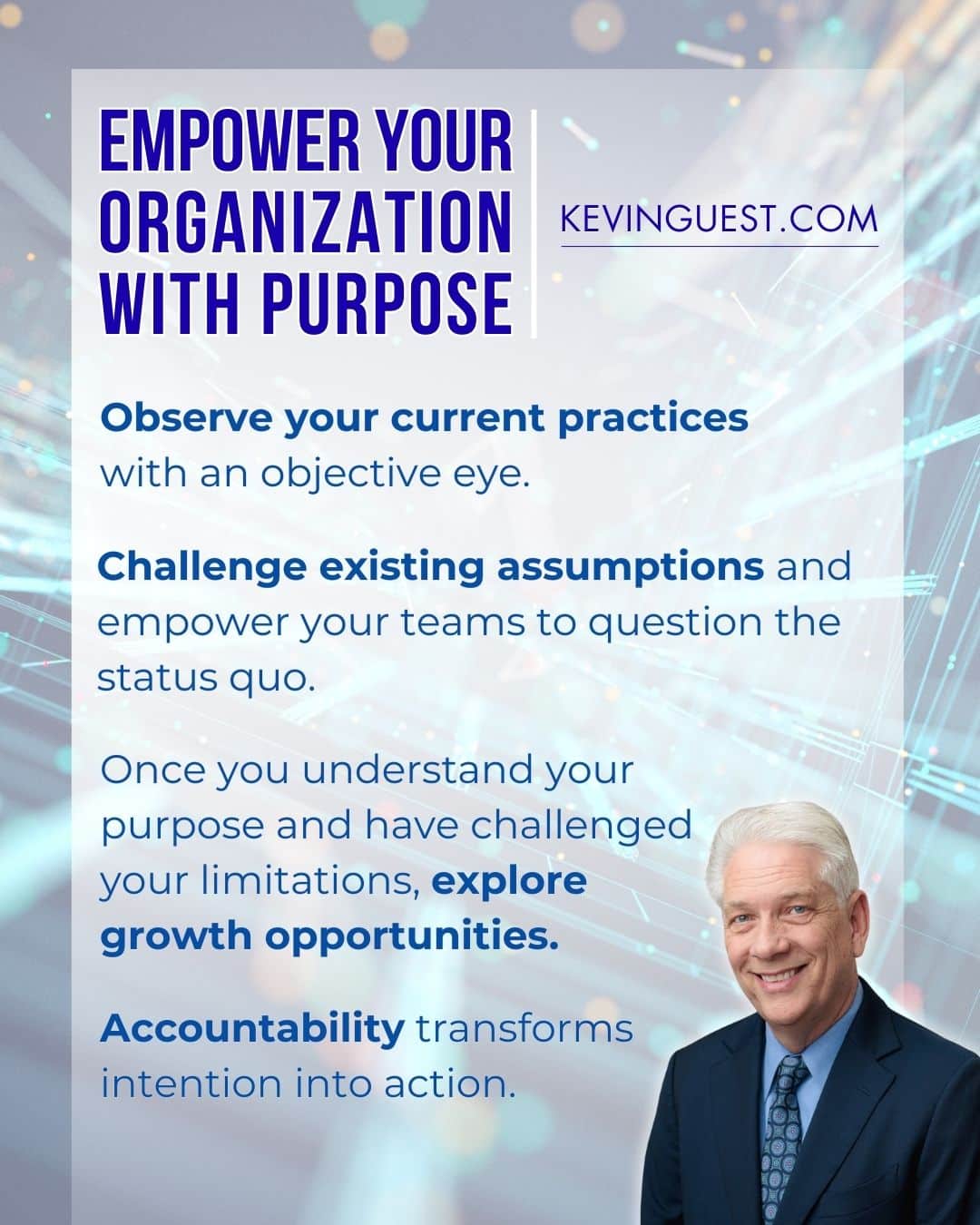
Empower Organization with Purpose | Kevin Guest

Save to share on your own social sites.

Without a clear answer, even the most ambitious efforts can feel lost and directionless (is that a word?). Finding that clarity is the first step toward genuine strategic advancement. So I ask my teams: How do we achieve it? It begins with a candid assessment of the present.

Empower Your Organization with Purpose

First, you must observe your current practices with an objective eye. To me, this means looking beyond established routines and processes. Analyze what works, what doesn’t, and what has become an institutional habit rather than a strategic asset. Our team has found huge value in this single practice.

By scrutinizing our own operations, we’ve identified redundancies and unearthed opportunities that were hidden in plain sight. This isn’t about finding fault; it’s about gaining the crucial insights needed to build a stronger future.

Second, you must challenge existing assumptions. Every industry, every company, is built on a set of beliefs about what is possible. But are those beliefs still valid today? Are they enabling growth or creating barriers? True innovation begins when you empower your teams to question the status quo.

For example, ask “What if we approached this problem from a completely different angle? What if the market has changed in a way we haven’t yet acknowledged?” By fostering a culture of intellectual curiosity, you transform your organization from one that simply follows trends to one that creates them.

Clarity Lights the Path Forward

This leads directly to the third element: exploring new opportunities for growth. Clarity illuminates the path forward. Once you understand your purpose and have challenged your limitations, you can begin to execute a plan with precision and confidence.

For us in the nutritional supplement industry, the vision is clear: to become the Gold Standard. This isn’t just a slogan; it’s a strategic directive that informs every decision we make, from research and development to customer experience. Your vision must be equally bold and specific. It should be the benchmark against which all progress is measured.

However, a vision without execution is merely a dream. A well-crafted plan is essential, but it is accountability that truly powers results.

Accountability transforms intention into action. It creates a framework where every team member understands their role in achieving the collective goal and takes ownership of their contribution. When accountability is woven into your culture, performance is no longer a matter of hope, it becomes a predictable outcome. It drives a cycle of continual improvement, where successes are celebrated and setbacks become valuable learning experiences.

A Disciplined Process

Ultimately, achieving extraordinary success is a disciplined process. It starts with an unwavering commitment to understanding your “why.” From there, you must gain clarity by observing, challenging, and exploring. With that clarity, you can execute a strategic plan aimed at industry leadership.

Finally, you must embed accountability at every level to ensure those plans deliver tangible, measurable results.

I encourage you to apply these principles not as a checklist, but as a continuous leadership philosophy. Empower your organization with purpose, and you will unlock its greatest potential.

Are we connected on LinkedIn? There, I share posts about professional development skills, self-care reminders, and other relevant topics.
Timeless Lessons for a 2026 Growth Mindset

As leaders everywhere set sights on the new year, I encourage professionals to embrace a growth mindset as the key to lasting achievement and fulfillment.

Success is about the experiences you have, the relationships you build, and the lessons you apply.

As Executive Chairman of USANA Health Sciences, four traits stand out to me when it comes to building a growth mindset:

  1. Resilience to navigate setbacks
  2. Curiosity to keep learning
  3. Purpose to fuel meaningful action
  4. Awareness to identify both opportunities and risks

Leaders and teams who lean into these qualities can see real results, whether in professional or personal development.

In All the Right Reasons, I recall a pivotal moment early in my career when a rushed business decision and ignoring my gut led to a major financial loss.

It stung, without a doubt. But that pain reshaped the way I do business today, and I’ve found that the hardest moments often teach us the most. That’s where growth lives.

Growth Mindset Strategies

For anyone looking to take their own mindset to the next level in 2026, I suggest four initial strategies:

  1. Find mentors who challenge and inspire you
  2. Practice positive self-talk, which is more powerful than most think
  3. Look for ways to serve others, inside and outside the office
  4. Never underestimate the quiet nudge of intuition; it can point you to your best decisions

I shared a version of this article in a news release on Jan. 5, 2026. USANA Health Sciences, a global leader in health and wellness products, has long recognized the importance of social wellness in building a successful business. Since its founding in 1992, USANA has focused on clear, concise communication to build trust with its customers and distributors in 25 countries. For more information about USANA Health Sciences and its dedication to promoting health, wellness, and entrepreneurial success, visit USANA.com. 

How Underdogs Flip the Script & Win Big

Have you ever found yourself cheering for the underdog? I mean, really rooting for them? We all do it. Think about it: Rocky Balboa, Harry Potter, Rudy, David and Goliath. These aren’t just great stories; they’re blueprints for success. They show us that the biggest wins don’t always come from having the most resources. They come from having the most heart, the sharpest strategy, and unwavering self-belief.

Today is National Underdog Day, the perfect time to look closer at this. What is the secret sauce that makes underdogs so powerful? And more important, how can we, as leaders and professionals, harness that same energy to shatter expectations, especially when the odds are stacked against us?

The Strategic Power of Being Underestimated

Underdogs have this incredible ability to surprise everyone. In business, just like in the movies, being seen as the long shot can actually be a massive advantage. When you learn to use these unique strengths, they become your secret weapon.

The Freedom to Innovate

Here’s something I’ve seen time and again: the front-runners often get stuck. They have established processes, reputations to protect, and a whole lot of red tape. For them, changing direction is like trying to turn a cruise ship in a bathtub. But for the underdog? It’s an open field. There’s less to lose and everything to gain.

This creates an environment ripe for bold experiments and lightning-fast pivots. When I was building my own video production company, we didn’t have layers of management or outdated systems holding us back. We could move quickly, think creatively, and completely change our game plan overnight. That agility is a superpower.

Unmatched Hunger and Drive

Success can make you comfortable. Comfort can make you complacent. But underdogs? They are never complacent. They fight for every single inch. Think about Rudy Ruettiger. Everyone told him he was too small to play football for Notre Dame. But he was too driven to listen. Every single setback just made him more focused. Every small win fueled his fire.

That kind of relentless drive, born from navigating tough challenges, is priceless. It doesn’t matter if you’re leading a multinational corporation or launching a new project. That hunger is what separates good from great.

The Element of Surprise

Let’s be honest, the big players are usually so busy competing with each other that they barely notice the smaller competitor in their rearview mirror. That’s the underdog’s moment. While the giants are distracted, the underdog is quietly building strength, refining their strategy, and waiting for the perfect time to strike.

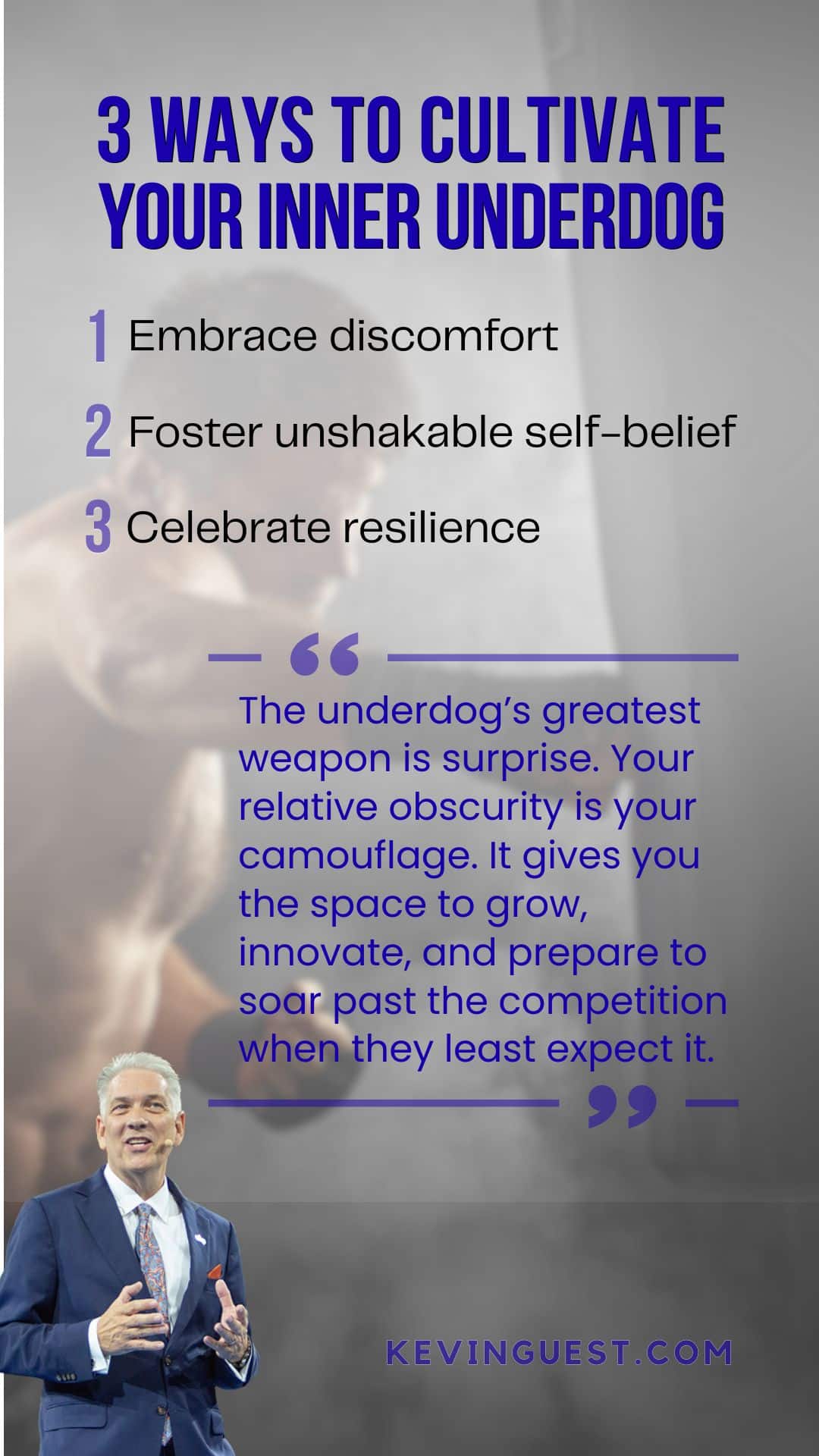
Like David with his sling, the underdog’s greatest weapon is surprise. Your relative obscurity is your camouflage. It gives you the space to grow, innovate, and prepare to soar past the competition when they least expect it.

3 Ways to Cultivate Your Inner Underdog Kevin GuestCultivating Your Inner Underdog

You don’t have to be the smallest player in the market to benefit from an underdog mentality. In fact, the most successful leaders I know actively cultivate this mindset, no matter their company’s size. It’s what drives sustainable growth, continuous innovation, and powerful resilience. So, how can you build it for yourself and your team? I have three suggestions.

1. Embrace Discomfort

Comfort is the enemy of progress. It’s just that simple. Underdogs are used to discomfort and scarcity; they’ve learned how to thrive in uncertain environments. As a leader, you must be willing to push beyond the status quo. Take on those challenging projects. Give your teams the autonomy to experiment, to try new things, and yes, even to fail.

Ask yourself: When was the last time you did something truly uncomfortable to chase a goal? When did you give your team the freedom they need to innovate and excel? Pushing boundaries is where growth happens.

2. Foster Unshakable Self-Belief

Every underdog story begins with belief. Sometimes, it’s just one person who holds that belief against all odds. Think of Harry Potter, the orphan living under the stairs who believed he was meant for something more. Leaders must be the chief evangelists for their mission and their people, especially when the pressure is on.

Your confidence as a leader is the bedrock. It provides the stability and inspiration for your team to achieve incredible things. When you believe, they believe.

3. Celebrate Resilience

Setbacks are not failures. They are data points. They are opportunities to learn, adapt, and come back stronger. Rocky Balboa didn’t win his first fight against Apollo Creed. But that loss made him a better fighter and set him up for his ultimate victory.

In business, we have to treat setbacks as stepping stones. We need to de-stigmatize failure and build a culture that celebrates resilience, learning, and adaptability. That is how you build a team that can weather any storm.

Your Turn to Rise to the Challenge

The underdog story speaks to a fundamental human truth: we are capable of so much more when we refuse to accept limitations and meet adversity with determination. Passion, focus, and resilience can overcome almost any obstacle. History and business are filled with examples.

So today, on National Underdog Day, take a look at the horizon. Identify the challenges and the Goliaths you face. Then, make a conscious choice to embrace the underdog’s path. Be hungrier. Move faster. Cultivate that unshakeable belief in yourself and your team. Let this be the start of your own comeback story, because the underdog’s advantage is real, and it’s yours for the taking.

Are we connected on LinkedIn? There, I share posts about professional development skills, self-care reminders, and other relevant topics.
The Most Meaningful Gifts Are the Ones Money Can’t Buy

Creative gestures and shared experiences form the foundation of lasting love.

National Make a Gift Day (Dec. 3) is a call to generosity and intentionality, encouraging people to craft something meaningful for someone they care about.

Meaningful Gifts | Kevin GuestLong before I led USANA Health Sciences or became a bestselling author, I was a college student trying to win the heart of a woman who would eventually become my wife. The problem? She had a serious boyfriend.

I knew if I was going to win her heart, I had to be extraordinary—and extraordinarily creative. That meant no typical dinners or movies. Instead, I turned dates into personalized experiences: a surprise meal and firepit outside ancient ice caves, a science-lab-themed dinner, drinking through beakers and test tubes, and impromptu jam sessions where couples formed their own makeshift bands in the music room.

We came up with all sorts of creative activities. And we still enjoy creative dates to this day.

Decades later, my wife and I are still crafting creative memories. For our 30th anniversary, we leaned into humor and heart, camping at a Walmart in our RV and dressing in thrifted leisure suits to make a music video for our kids.

Gifts aren’t always wrapped in bows. Sometimes the best gift is presence, effort, and creating a memory together. Those are the things that last.

I often speak about the power of service and creativity in building strong relationships—both personally and professionally. My book All the Right Reasons: 12 Timeless Principles for Living a Life in Harmony explores these themes through real-life stories and heartfelt lessons.

Service and Creativity: The Lasting Impact

The principles behind creative giving (e.g., intentionality, presence, and connection) can also strengthen relationships, boost resilience, and inspire service. In fact, my book’s proceeds support the USANA Foundation, which provides food and nutrition to underserved communities worldwide.

Service is one of the most powerful ways we can uplift others and nourish our own well-being.

To date, All the Right Reasons has provided more than 1.8 million meals through its partnership with the USANA Foundation. Each book purchased contributes 40 meals to those in need.

I shared a version of this article in a news release on Dec. 3, 2025. USANA Health Sciences, a global leader in health and wellness products, has long recognized the importance of social wellness in building a successful business. Since its founding in 1992, USANA has focused on clear, concise communication to build trust with its customers and distributors in 25 countries. For more information about USANA Health Sciences and its dedication to promoting health, wellness, and entrepreneurial success, visit USANA.com. 

Smart Leaders Learn from Everyone

Great leaders know one thing for sure: growth isn’t a solo journey.

The most transformative insights often come from the people around us. That’s the heart of what I call the Plato Principle, a concept I explore in my book, All the Right Reasons. It’s about committing to learn from everyone and intentionally broadening your perspective beyond your own experiences.

Here’s the beauty of it: every person you meet has lived through something you haven’t. They carry unique experiences, knowledge, and perspectives that can challenge your assumptions, refine your thinking, and sharpen your judgment. All it takes is a little curiosity. When you approach conversations with an open mind, every interaction becomes an opportunity to grow.

This holiday season, as you gather with family and friends, you have the perfect chance to put the Plato Principle into action. So, how can you use it to fuel your own growth? Here are a few simple steps to transform your conversations into something truly meaningful.

The Plato PrincipleApply the Plato Principle

1. Lead with Curiosity

Instead of waiting for an opening to share your own thoughts, start by asking better, more open-ended questions. Move beyond surface-level topics and try prompts like, “What’s a challenge you’ve been thinking about recently?” or “What’s a perspective you hold that others often disagree with?” WOW. That can instantly invite deeper, more meaningful dialogue.

2. Listen to Understand, Not to Respond

Remember, the goal is to absorb, not to rebut. When someone shares an opinion that differs from your own, resist the immediate urge to counter-argue. Instead, focus on understanding their reasoning. A simple phrase like, “Let’s get curious about that,” can shift the dynamic from debate to discovery.

3. Seek Out Different Viewpoints

Make a conscious effort to engage with people whose backgrounds and roles differ from yours. At a family gathering, this might mean talking to a younger cousin about their view on technology. In a professional setting, it could involve having lunch with someone from a completely different department. Each conversation offers a unique lens on the world.

———

I’ve noticed that the best leaders, the ones who truly stand out, are always learning from others. They build stronger teams, spark innovation, and consistently deliver better results. They are also the ones who bring fresh ideas to the table and help everyone level up.

When you embrace the Plato Principle, even a casual holiday conversation can become a turning point for your leadership journey. You might be surprised by the insights you uncover, insights that sharpen your perspective and strengthen your connections with the people who matter most.

Are we connected on LinkedIn? There, I share posts about professional development skills, self-care reminders, and other relevant topics. Here’s a video from 2019 in which I discuss the Plato Principle in action.
Lead with Authenticity, Empathy, & Moral Clarity

As business leaders worldwide focus on re-energizing workforces after years of upheaval, I urge CEOs to lead with renewed authenticity, empathy, and moral clarity. I call these principles “the real foundation of sustainable success.”

No doubt, technology and strategy will always matter. But what truly binds a company together is trust. When people feel seen, valued, and inspired, they do their best work, and that’s how you create a culture that thrives through any storm.

This notion aligns with a growing leadership movement that emphasizes employee well-being, personalized experiences, and transparent communication. As CEOs champion what many call the “great re-engagement,” I believe the key lies not in new perks or digital platforms, but in timeless human connection.

The best leaders don’t just talk about values; they live them. Every decision should be made for all the right reasons, not just the convenient ones.

A Leader Guided by Principle and Purpose

In All the Right Reasons: 12 Timeless Principles for Living a Life in Harmony, I draw on my personal experiences—from rebuilding after loss to navigating corporate challenges—to illustrate that values-driven leadership is both a moral compass and a business advantage.

I recount scrapping a multimillion-dollar product batch at USANA rather than compromising on quality, a decision that solidified USANA’s reputation for integrity. When you commit to your core values, you change your destiny.

That principle echoes my current call for executives to prioritize holistic employee wellness—mental, physical, and financial health—as a business imperative, not a benefit.

You can’t separate people’s well-being from their performance. When leaders invest in the whole person, they build loyalty that no salary can buy.

Central to this philosophy is what I call “The Dorothy Principle.” It’s a concept that says, Nothing is more important than relationships. Genuine connections are the most valuable asset in any endeavor.

People matter more than things. I partly measure success by the number of lives improved as a result of what I do and by the quality of my personal, one-on-one relationships.

This perspective challenges leaders to look beyond transactional interactions and invest in the well-being of those around them.

From Music to Mission

My career reflects a harmony between passion and purpose. A lifelong musician, I once gave up my dream of becoming a full-time rock performer to follow a deeper calling.

Music taught me about rhythm and harmony. But life taught me that true harmony comes from aligning what you do with what you believe.

This “life in harmony” philosophy has shaped both my leadership at USANA and my mentorship of emerging leaders worldwide. All the Right Reasons (Amazon link) reminds readers that lasting success comes from integrity, gratitude, and service to others.

Looking Ahead

I envision a future where companies serve not only shareholders, but also stakeholders, including employees, families, and communities. If we want to re-engage our teams, we must re-engage our humanity. That’s the kind of leadership that endures.

I shared a version of this article in a news release on Nov. 3, 2025. All the Right Reasons offers further insights into expressing empathy and finding purpose. All proceeds go to feeding hungry children, and each book purchase provides 40 meals. 

USANA Health Sciences, a global leader in health and wellness products, has long recognized the importance of social wellness in building a successful business. From its founding in 1992, USANA has focused on clear and concise communication to build trust with its customers and distributors in 25 countries. For more information about USANA Health Sciences and its dedication to promoting health, wellness, and entrepreneurial success, visit USANA.com.