Self-Care: Key to Living a Balanced Life
I believe self-care is critical to our overall well-being, especially when our daily routines are turned upside down. HealthCorps posted a Venn diagram on its Instagram that illustrates the importance of this concept.
The diagram shows how mental, physical, and emotional care intersect to contribute to self-care. Self-care is, according to Oxford, “the practice of taking action to preserve or improve one’s own health.”
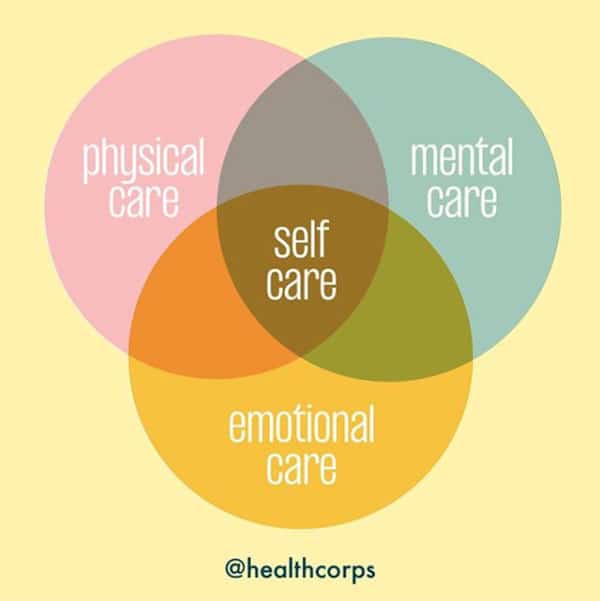
HealthCorps shared this image on its Instagram on April 14, 2020. It demonstrates how self-care is at the center of our overall wellbeing.
It’s a concept that I try to keep top-of-mind. However, it’s also something that can be easily forgotten or brushed aside. Nearly half (44%) of respondents in a 2019 Harris Poll (PDF) believe self-care is only possible for people with “enough” time. I take that to mean that outside influences are demanding so much of their time that they don’t have any left for themselves.
Yes, we’re all busy and many of us are stretched in countless directions. But, for the sake of our own well-being, we should all strive to make time for self-care.
To get in the right frame of mind, I often ask myself these questions:
- What activities am I performing daily that enrich my health?
- Am I taking time for me to refuel and recharge after encountering stressors?
- How do my interactions with others contribute to not only their well-being but also to mine?
Self-Care is Not Selfish
As you might remember, earlier this year I wrote about kindness. In that article, I focused on how we can be a little kinder, a little happier, and a little better in our relationships with others. Obviously, that’s still very important.
But we also should remember to be kind to ourselves.
I’ve heard stories recently about how parents with school-age children are feeling especially overwhelmed right now. With schools closed in many areas, the home now doubles as the classroom. Students are feeling increased pressures to adapt to a new learning environment. And parents, who are also under a tremendous amount of stress, are beating themselves up for not being able to excel as parents and teachers. Nevermind that the adults in this scenario are trying to do this while also navigating a challenging time in history. (It’s also a good reminder that we should be extra-kind to the teachers in our — and our children’s — lives).
If you’re feeling this way, I encourage you to give yourself a break. It might help to explore various self-care exercises.
Though this What’s Up, USANA? article explored self-care from a new-mom point of view, it still provides tips for all of us.
A Forbes article highlighted ways we can practice self-care as well (read the 10 ways). It also explains why taking care of ourselves — physically, mentally, and emotionally — is so important. Among the reasons:
- It allows you to know your own worth, reminding you and others of your importance
- Taking time for yourself naturally aligns your work-life balance
- Developing self-care habits helps you to reduce stress
I believe it’s necessary for us to continue moving forward in uncertain times. It’s important to keep looking ahead. Yet, it’s equally as important to reflect on where we’ve (metaphorically) traveled in our life, what we’ve accomplished, and how we’ve made a difference in the lives of others.
For me, this type of reflection is a key part of my self-care.
 Author